
Table of Contents
Spinal decompression in Tysons can provide meaningful relief for back pain — particularly when it targets the disc-related and nerve compression issues driving your symptoms.
At RxWellness Spine & Health, spinal decompression is one component of a personalized, multidisciplinary care plan designed to address the root cause of your pain rather than just masking it. “It is estimated that up to 80% of people will experience low back pain at some point during their lifetimes” — NCBI Bookshelf – Back Pain in the United States.
For those living with persistent back pain in the Northern Virginia area, understanding your options is the first step toward recovery.
Related: When Do I Need a Back Chiropractor Near Me in Tysons?
What Causes Chronic Back Pain and When Should You Seek Treatment?
Chronic back pain rarely has a single cause. Most patients arrive at care after months of worsening discomfort, failed self-treatment, or recurring flare-ups that disrupt sleep, work, and daily movement. Understanding what is driving your pain is essential to finding a lasting solution.
“The prevalence of chronic, impairing LBP rose significantly over the 14-year interval, from 3.9% (95% confidence interval [CI], 3.4%-4.4%) in 1992 to 10.2% (95% CI, 9.3%-11.0%) in 2006” — Freburger JK, et al. Archives of Internal Medicine, 2009 / PMC.
Disc Degeneration and Herniation
The intervertebral discs that cushion your vertebrae are among the most common sources of chronic low back pain, particularly as they lose hydration and structural integrity over time. Disc degeneration and herniation are especially prevalent in adults aged 30-50, most frequently affecting the L4–L5 and L5–S1 levels.
- Age-related disc desiccation reduces shock absorption
- Herniated nucleus pulposus compresses adjacent nerve roots
- Degenerative disc disease causes progressive height loss and instability
- Radicular leg pain signals nerve root involvement
Disc-related pain often worsens with prolonged sitting or bending. Still, the underlying structural changes require more than rest to resolve.
Mechanical and Postural Contributors
Not all chronic back pain originates from disc pathology — many cases involve accumulated strain from poor movement patterns, muscle imbalances, and sustained postures that overload spinal structures.
- Anterior pelvic tilt increases lumbar compressive forces
- Weak core musculature shifts the load onto passive spinal structures
- Repetitive flexion and extension accelerate facet joint wear
- Prolonged sitting elevates intradiscal pressure significantly
Addressing mechanical contributors is important, but it rarely eliminates pain without also treating the structural changes that have developed over time.
Warning Signs That Warrant Professional Care
Some back pain resolves with rest and minor self-care. When it does not — or when specific symptoms appear — prompt evaluation is important to rule out serious underlying conditions.
- Pain lasting more than six weeks without improvement
- Radiating leg pain, tingling, or numbness below the knee
- Pain that worsens at night or with prolonged standing
- Bladder or bowel changes alongside back symptoms (seek urgent care)
New to RxWellness? Your first visit — including consultation, examination, and treatment — is just $19. Book your new patient appointment today!
What Are the Treatment Options for Chronic Back Pain?
Chronic back pain has a wide spectrum of treatment options ranging from simple self-care measures to advanced interventional procedures. Selecting the right approach depends on your specific diagnosis, symptom severity, and how long you have been dealing with pain.
“Traction is the most common modality used in non-surgical spinal decompression (NSD) therapy. The NSD therapy is intended to offer a motorized segmental distraction for a predetermined amount of time, thus leading to physical changes in the disc” — El Melhat AM, et al. Journal of Clinical Medicine.
Conservative and Self-Care Approaches
Before any clinical intervention, most guidelines recommend a course of conservative measures to manage acute pain and reduce inflammation. These approaches are low-risk and appropriate for most patients in the early stages of back pain.
- Rest and activity modification for acute flare management
- Ice and heat alternation to reduce inflammation and muscle tension
- NSAIDs and over-the-counter analgesics for short-term symptom control
- McKenzie exercises and postural education for mechanical low back pain
Conservative self-care can reduce immediate symptoms, but it rarely resolves the underlying structural issues responsible for recurring or chronic pain.
Non-Surgical Spinal Decompression
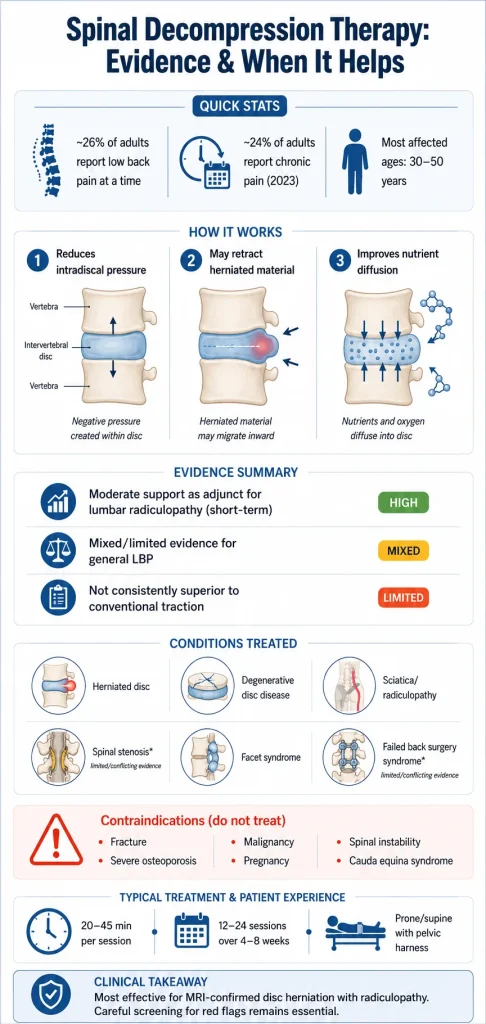
Non-surgical spinal decompression in Tysons uses a motorized, computer-controlled table to apply precise distraction forces to the lumbar spine — reducing intradiscal pressure, creating space for compressed nerve roots, and encouraging disc rehydration. Research supports its use as part of a multimodal program, particularly in patients with disc herniation and radiculopathy.
- Motorized traction reduces intradiscal pressure to therapeutic levels
- Segmental distraction may draw herniated disc material centrally
- Flexion-distraction chiropractic techniques produce similar pressure reductions
- Most effective when integrated with exercise and manual therapy
Invasive Interventions and Surgical Decompression
For patients who do not respond to conservative care, more invasive options may be considered — from epidural steroid injections to surgical procedures such as discectomy or laminectomy that directly decompress affected neural elements.
- Epidural steroid injections for short-term radicular symptom reduction
- Minimally invasive discectomy for persistent herniation with neurologic deficit
- Laminectomy or fusion for spinal stenosis or structural instability
- Surgery is typically reserved for progressive neurologic compromise or failure of conservative care
What Are the Benefits of Spinal Decompression in Tysons for Chronic Back Pain?
Spinal decompression offers a non-surgical pathway to pain relief that targets the disc-level mechanics responsible for many types of chronic back pain, without incisions, medication dependency, or extended recovery time.
“It was concluded that a combination of non-surgical spinal decompression therapy with routine physical therapy is more effective, statistically and clinically, than routine physical therapy alone in terms of improving pain, lumbar range of motion, back muscle endurance, functional disability, and physical role domain of quality of life, in patients with lumbar radiculopathy, following 4 weeks of treatment.” — Amjad F, et al. BMC Musculoskeletal Disorders
Intradiscal Pressure Reduction
One of the most documented mechanical benefits of spinal decompression is its ability to reduce pressure within the intervertebral disc, creating conditions for healing rather than continued breakdown.
Laboratory studies have confirmed that distraction-based techniques can generate genuinely negative intradiscal pressures — a range unreachable through rest or exercise alone.
- Negative intradiscal pressure may reverse herniation pressure gradients
- Reduced disc pressure allows fluid and nutrient reabsorption
- Nerve root decompression reduces radicular pain signals
- Flexion-distraction chiropractic produces meaningful pressure reductions at multiple lumbar levels
Improved Function and Pain Relief
Clinical studies show that decompression-based treatment produces measurable improvements across multiple dimensions of patient function.
A 2022 randomized controlled trial demonstrated significant gains in pain intensity, lumbar range of motion, back muscle endurance, and health-related quality of life when decompression was added to a standard physical therapy program.” — Amjad F, et al. BMC Musculoskeletal Disorders.
- Statistically significant pain reduction on validated VAS scoring
- Improved lumbar flexion and extension range of motion
- Greater back muscle endurance following a four-week protocol
- Reduced disability scores and improved quality-of-life measures
Decompression as Part of Multimodal Care
The strongest evidence for spinal decompression in Tysons places it within a broader care program. When combined with physical therapy, chiropractic adjustments, and exercise, decompression produces outcomes that neither modality achieves as effectively on its own.
- Multimodal protocols outperform single-modality decompression in RCT evidence
- Decompression may reduce muscle guarding, improving the effectiveness of adjustments
- Sequential decompression and manual care address both disc and joint contributors
- Exercise and postural training sustain decompression gains between sessions
If you’re ready to find lasting relief from chronic back pain in Tysons, our team at RxWellness is here to help. Call (571) 605-2783 to schedule your consultation today.
What Should You Expect During Spinal Decompression Treatment?
Many patients approach spinal decompression with uncertainty about what the treatment involves and whether it will be uncomfortable. In practice, most people find sessions relaxing — the controlled, gradual stretching feels very different from the sudden movements sometimes associated with manual care.
Your Initial Evaluation and Care Plan
Spinal decompression at RxWellness Tysons begins with a thorough consultation and examination to confirm candidacy and identify the spinal levels, disc conditions, and contributing factors your care plan will address.
- Comprehensive neurological and orthopedic evaluation on your first visit
- On-site digital X-ray available to assess spinal alignment and disc spacing
- Review of your symptom history, duration, and any prior imaging
- Personalized care plan presented at your second visit with clear timelines and costs
The Decompression Session Itself
During a session, you lie on a specialized motorized table with a pelvic harness connected to the traction mechanism. The table applies precise, computer-controlled distraction forces — gradually increasing and releasing tension in a rhythmic pattern designed to separate vertebral segments without triggering muscle guarding.
- Sessions typically last 20–45 minutes in a reclined, supported position
- Distraction force is calibrated to your body weight, disc level, and symptom response
- No sudden thrusting or high-velocity movements are involved
- Most patients experience mild stretching and pressure relief during treatment
Tracking Progress Over Time
Measuring progress objectively allows your care team to make informed adjustments and confirm that therapy is producing the intended results. Clinical trials studying spinal decompression use several validated tools that your provider may also employ.
- Pain intensity is tracked with visual analog or numeric rating scales
- Functional disability assessed using the Oswestry Disability Index
- Lumbar range of motion is measured at key intervals throughout care
- Imaging may be used to assess structural changes when indicated
Is Spinal Decompression Right for Your Chronic Back Pain?
Spinal decompression in Tysons is most effective when the correct structural diagnosis is confirmed, and contraindications are ruled out. The most important step is a thorough clinical evaluation that matches the treatment to your specific condition, within a broader conservative care plan.
Ideal Candidates for Decompression Therapy
Patients most likely to benefit share clinical characteristics that align with the treatment’s mechanism of action. Clinical research consistently identifies disc-related diagnoses — particularly with nerve involvement — as the strongest indicators for decompression therapy.
- MRI or imaging-confirmed lumbar disc herniation or bulge
- Chronic low back pain is typically three or more months in duration
- Radiculopathy with radiating pain, numbness, or tingling into the leg
- Prior conservative care that provided only partial or temporary relief
Conditions That Respond Best
While spinal decompression is most commonly associated with disc herniation, clinical evidence suggests a broader range of disc-related conditions can respond favorably.
- Degenerative disc disease with discogenic low back pain
- Lumbar spinal stenosis, particularly with the flexion-distraction technique
- Facet syndrome contributing to chronic lumbar pain
- Sciatic nerve irritation from foraminal compression
When Decompression May Not Be Appropriate
Certain conditions represent absolute or relative contraindications that your provider will screen for during evaluation. These appear consistently as exclusion criteria across clinical trials.
- Vertebral fracture, tumor, or serious spinal pathology
- Severe osteoporosis or active spinal infection
- Pregnancy or prior spinal fusion with hardware
- Cauda equina syndrome or severe progressive neurologic deficit (requires urgent surgical evaluation)
How Long Does Spinal Decompression in Tysons Take to Work?
Response timelines vary based on diagnosis, symptom chronicity, and whether decompression is part of a multimodal program. Understanding realistic timelines helps you commit to the full course of care rather than stopping before the treatment has a chance to produce lasting results.
“Intradiscal pressure demonstrated an inverse relationship to the tension applied. Tension in the upper range was observed to decompress the nucleus pulposus significantly, to below -100 mm Hg”— Ramos G, Martin W. Journal of Neurosurgery.
Typical Treatment Schedules
Clinical trials studying non-surgical spinal decompression use protocols of 12–24 sessions over four to eight weeks — the time needed for disc-level changes to accumulate and for the nervous system to adapt to reduced pressure.
- Most protocols involve three to five sessions per week initially
- A standard course runs four to six weeks for active decompression
- Session frequency reduces as symptoms improve
- Some protocols include a tapering maintenance phase to consolidate gains
What the Research Shows About Timing
The strongest randomized controlled trials show measurable improvements in pain, function, and disability within four weeks when decompression is combined with physical therapy, based on 12 structured sessions, not sporadic treatment.
- Significant pain reduction is often measurable within the first two to three weeks
- Functional gains in range of motion and endurance typically follow pain relief
- Patients with longer-standing symptoms may require extended courses
- Consistency across the full protocol correlates strongly with better outcomes
Sustaining Results Long-Term
Structural gains from decompression are best maintained when patients transition to active strategies that prevent the mechanical conditions responsible for their original pain from returning.
- Home exercise programs reinforce disc hydration and spinal stability
- Periodic chiropractic maintenance visits reduce recurrence risk
- Ergonomic adjustments at work and home protect lumbar disc health
- Active lifestyle changes support lasting recovery
Related: When Should I See a Doctor for Sciatica in Tysons?
Why Choose RxWellness Spine & Health in Tysons?
RxWellness Spine & Health has built a reputation for multidisciplinary excellence across the Tysons and McLean corridor, delivering personalized care that integrates spinal decompression with the full range of chiropractic and wellness services chronic back pain patients need.
- Ranked #1,523 on the Inc. 5000 list of America’s fastest-growing private companies (2025)
- Ranked #45 on the Inc. Regionals Mid-Atlantic list (2025)
- 150,000+ patients treated across 12 Virginia and Maryland locations
- 7,500+ five-star reviews reflecting consistent patient outcomes
- Board-certified chiropractors trained in Webster, Gonstead, Thompson, and Chiropractic Biophysics techniques
- Advanced soft tissue care and extremity treatment available on-site
- Major insurance accepted: Aetna, BCBS, CareFirst, Cigna, FSBP, GEHA, Medicare, and UHC
- Same-day appointments available for new patients
The RxWellness Three-Phase Care Model
Every care plan at RxWellness Tysons follows a structured, progressive framework built to move you from pain relief through lasting recovery:
- Phase 1 – Relief Care: Reduce pain and inflammation through targeted decompression, adjustments, and soft tissue work
- Phase 2 – Corrective Care: Address underlying biomechanical contributors with rehabilitation, exercise, and structural correction
- Phase 3 – Wellness Care: Maintain progress and prevent recurrence through periodic care and lifestyle strategies
What Spinal Decompression Treatments Are Available at RxWellness Tysons?
RxWellness Tysons pairs spinal decompression with complementary services that extend and reinforce its benefits. Your care team selects and sequences treatments based on your specific diagnosis, symptom picture, and recovery goals.
Spinal Decompression Therapy
RxWellness Tysons uses a motorized decompression table to apply precisely controlled, intermittent distraction forces to the lumbar spine, creating negative intradiscal pressure that mechanically offloads compressed discs and nerve roots.
- Targets herniated, bulging, and degenerative discs at specific lumbar levels
- Calibrated distraction force adjusted to your body and diagnosis
- Non-surgical, non-invasive, and appropriate for most disc-related conditions
- Typically combined with chiropractic care and soft tissue therapy for the best results
Chiropractic Care
The Tysons team brings exceptional breadth of technique certification — including Webster, Palmer package, Gonstead, Thompson, and Chiropractic Biophysics — allowing your provider to select the adjustment approach best suited to your spinal anatomy and presentation.
- Corrects vertebral misalignments contributing to nerve root compression
- Restores proper segmental motion and reduces mechanical irritation
- Multiple technique certifications allow a personalized approach selection
- Addresses cervical, thoracic, and lumbar involvement in a single visit
Massage Therapy
Therapeutic massage reduces the muscle tension and guarding that often accompany chronic disc-related pain, allowing the disc to decompress more fully and prolonging the effects of each session.
- Reduces paraspinal muscle hypertonicity that limits decompression efficacy
- Improves local circulation, accelerating tissue recovery
- Addresses myofascial trigger points that amplify disc-related pain
- Prepares soft tissue for chiropractic adjustment and active rehabilitation
Regenerative Medicine
For patients with significant disc degeneration, joint deterioration, or chronic inflammatory pain that has not responded to structural approaches alone, regenerative medicine at RxWellness Tysons offers an additional pathway using the body’s own healing mechanisms.
- PRP therapy concentrates platelets and growth factors to accelerate tissue repair
- A2M therapy inhibits the enzymes responsible for cartilage and disc breakdown
- PRF creates a sustained-release growth factor scaffold for prolonged healing support
- HCTP treatments introduce cellular materials that promote tissue regeneration
Ready to take the next step toward recovery? Schedule your consultation online to visit RxWellness Tysons today and begin your path to relief.
FAQs About Spinal Decompression in Tysons
Is spinal decompression safe for patients with disc herniation or degenerative disc disease?
For most patients with MRI-confirmed disc herniation or degenerative disc disease, non-surgical spinal decompression is a safe, non-invasive treatment option. Clinical trials consistently report few serious adverse events when patients are properly screened. Certain conditions — including fracture, severe osteoporosis, active spinal infection, and pregnancy — are contraindications evaluated at your initial consultation.
Does insurance cover spinal decompression in Tysons, VA?
RxWellness Tysons accepts Aetna, Blue Cross Blue Shield, CareFirst, Cigna, FSBP, GEHA, Medicare, and UHC. Coverage for spinal decompression varies by plan and diagnosis, and our team verifies your benefits before treatment begins. Patients without insurance can access the $19 New Patient Special, which covers a full evaluation, consultation, and first treatment session.
How long does spinal decompression take to relieve chronic back pain?
Most patients experience measurable pain reduction within the first two to three weeks of a structured protocol. A full course typically involves 12–24 sessions over four to six weeks, with frequency tapering as symptoms improve. Consistency throughout the full protocol — rather than stopping at the first sign of relief — correlates most strongly with durable outcomes.
What should I expect at my first spinal decompression appointment at RxWellness Tysons?
Your first visit includes a one-on-one consultation and comprehensive neurological and orthopedic examination, with on-site digital X-ray available if indicated. If decompression is appropriate for your condition, you may receive your first treatment on that same visit. We will present a detailed care plan, including the session schedule, expected timelines, and associated costs, at your second appointment. The $19 New Patient Special covers the full first-visit experience.
Who is a good candidate for spinal decompression therapy?
The best candidates are adults with disc-related chronic back pain — particularly imaging-confirmed herniation, degenerative disc disease, or lumbar radiculopathy — who have not achieved lasting relief through rest, medication, or basic physical therapy. Patients with symptoms lasting three or more months and those experiencing radiating leg pain or numbness are frequently strong candidates. Your RxWellness Tysons provider will confirm candidacy and rule out contraindications during your evaluation.
Key Takeaways
- Spinal decompression in Tysons is most effective as part of a multidisciplinary care plan that includes chiropractic adjustments, massage therapy, and targeted exercise — not as a standalone treatment.
- RxWellness Spine & Health in Tysons brings exceptional technique depth — including Gonstead, Thompson, Chiropractic Biophysics, and Webster certification — to every chronic back pain care plan.
- Non-surgical spinal decompression produces measurable reductions in intradiscal pressure and significant improvements in pain, range of motion, and disability when combined with physical therapy over four to six weeks.
- The RxWellness Three-Phase Care Model moves patients from acute pain relief to structural correction to long-term wellness, reducing the recurrence risk associated with symptomatic-only treatment.
- Spinal decompression is best suited to patients with MRI-confirmed disc herniation, degenerative disc disease, or lumbar radiculopathy; thorough evaluation at RxWellness Tysons confirms candidacy and rules out contraindications.
- RxWellness Tysons serves McLean, Great Falls, Wolf Trap, and surrounding communities with flexible scheduling, major insurance acceptance, and a $19 new patient entry point.
Related: Are Chiropractic Deals in Tysons Good for Long-Term Wellness?
Find Lasting Relief from Chronic Back Pain in Tysons
Chronic back pain does not have to be permanent — but it requires the right diagnosis, the right treatment, and a care team committed to long-term recovery. At RxWellness Spine & Health in Tysons, spinal decompression is paired with advanced chiropractic techniques, therapeutic massage, and regenerative medicine to deliver comprehensive, root-cause care that patients across Tysons and McLean trust.
RxWellness Spine & Health Tysons/McLean Online Reservations
8609 Westwood Center Dr, Suite 620, Vienna, VA 22182
Serving Tysons and nearby communities, including McLean, Great Falls, Wolf Trap, and Odricks Corner.