

Table of Contents
A high ankle sprain injures the ligaments that bind the two lower leg bones together above the joint, while a regular ankle sprain injures the ligaments on the outside of the ankle below it. The mechanism differs, the pain sits higher, and the recovery takes considerably longer, which is why misreading one as the other costs athletes entire seasons.
The distinction is worth knowing because the numbers are lopsided. More than 2 million acute ankle sprains are treated annually in the United States, with high ankle sprains representing roughly 1% to 10% of them. Rare, but disproportionately expensive in time lost.
What Is a High Ankle Sprain?
A high ankle sprain damages the syndesmosis, the ligament complex that holds the tibia and fibula together just above the ankle joint. Those ligaments resist the two bones separating when the foot rotates outward under load.
What the syndesmosis does
- Binds the tibia and fibula together above the joint.
- Resists the bones splaying apart during weight bearing.
- Keeps the ankle mortise stable as the foot rotates.
- Transfers force between the leg and the foot.
- Allows small, controlled motion during walking.
- Protects the joint surface from uneven loading.
How a high ankle sprain happens
- The foot planted and the body rotating outward over it.
- A tackle from the side while the foot stays fixed.
- Landing awkwardly with the foot turned out.
- A skiing or skating sports injury with the foot locked in a boot.
- Forced dorsiflexion combined with external rotation.
- A contact sports injury where a second player lands on the leg.
How a regular ankle sprain happens
- Rolling the foot inward, the classic inversion mechanism.
- Stepping on uneven ground or another player’s foot.
- Landing off balance from a jump.
- Approximately 70% of lateral sprains involve the anterior talofibular ligament.
- Forced inversion is the most common mechanism overall.
- Damage sits below and in front of the outer ankle bone.
New to RxWellness? Your first visit, including consultation, examination, and treatment, is just $19. Book your new patient appointment today.
Related: Muscle Strain Treatment: How to Relieve Pain and Support Recovery
How Do High Ankle Sprain Symptoms Differ?
High ankle sprain symptoms are separated from a rolled ankle by location and behaviour more reliably than by severity. A high ankle sprain often looks less dramatic in the first hours and then refuses to settle in the way a rolled ankle does.
High ankle sprain symptoms
- Pain above the ankle joint, often several inches up the leg.
- Discomfort when the foot rotates outward.
- Pain pushing off during walking or running.
- Difficulty with stairs and uneven surfaces.
- Swelling that may be modest compared with the pain.
- Bruising that appears higher up the lower leg.
- A sense the leg won’t tolerate rotation under load.
Regular ankle sprain symptoms
- Ankle pain and swelling around the outer ankle bone.
- Rapid, obvious swelling within the first hours.
- Bruising that tracks into the foot.
- Tenderness in front of and below the lateral malleolus.
- Pain rolling the foot inward.
- Faster early improvement in most cases.
Why high ankle sprain symptoms get missed
- Early swelling is often less impressive.
- Patients can frequently still walk on it.
- High ankle sprain symptoms sit above where people expect ankle pain.
- X-rays commonly appear normal.
- The injury gets labelled a mild sprain and rushed.
- High ankle sprain symptoms only declare themselves once loading resumes.
Related: Athletic Recovery and Chiropractic Health
How Is a High Ankle Sprain Diagnosed?
Examination tests do most of the sorting, and imaging rules out the fractures and separations that change management. Where the tenderness sits is the first and best clue.
Examination tests providers use
- Squeeze test, compressing the calf to reproduce pain higher up.
- External rotation stress test with the knee bent.
- Palpation mapping tenderness up the leg from the joint line.
- Anterior drawer, which assesses the lateral ligaments instead.
- Talar tilt, comparing inversion against the other side.
- Single-leg hop tolerance once acute pain settles.
When imaging is warranted
- Bony tenderness at the malleolus or midfoot.
- Inability to bear weight immediately and in clinic.
- Suspected separation of the tibia and fibula.
- Persistent ankle pain that outlasts the expected timeline.
- Planning before any surgical consultation.
- Ruling out a fracture higher up the fibula.
What the grading means
- Grade I involves stretching without instability.
- Grade II involves partial tearing with some laxity.
- Grade III involves complete rupture and gross instability.
- Lateral sprain recovery runs 1 to 2 weeks for grade I.
- Grade II lateral sprains run 3 to 6 weeks.
- Grade III lateral sprains run 6 to 12 weeks or longer.
If you’re ready to find lasting relief from a high ankle sprain, our team at RxWellness is here to help. Call the nearest RxWellness Spine and Health clinic to schedule your consultation today.
Related: How Sports Injury Rehabilitation Helps You Recover Faster
How Long Does Each Injury Take to Heal?
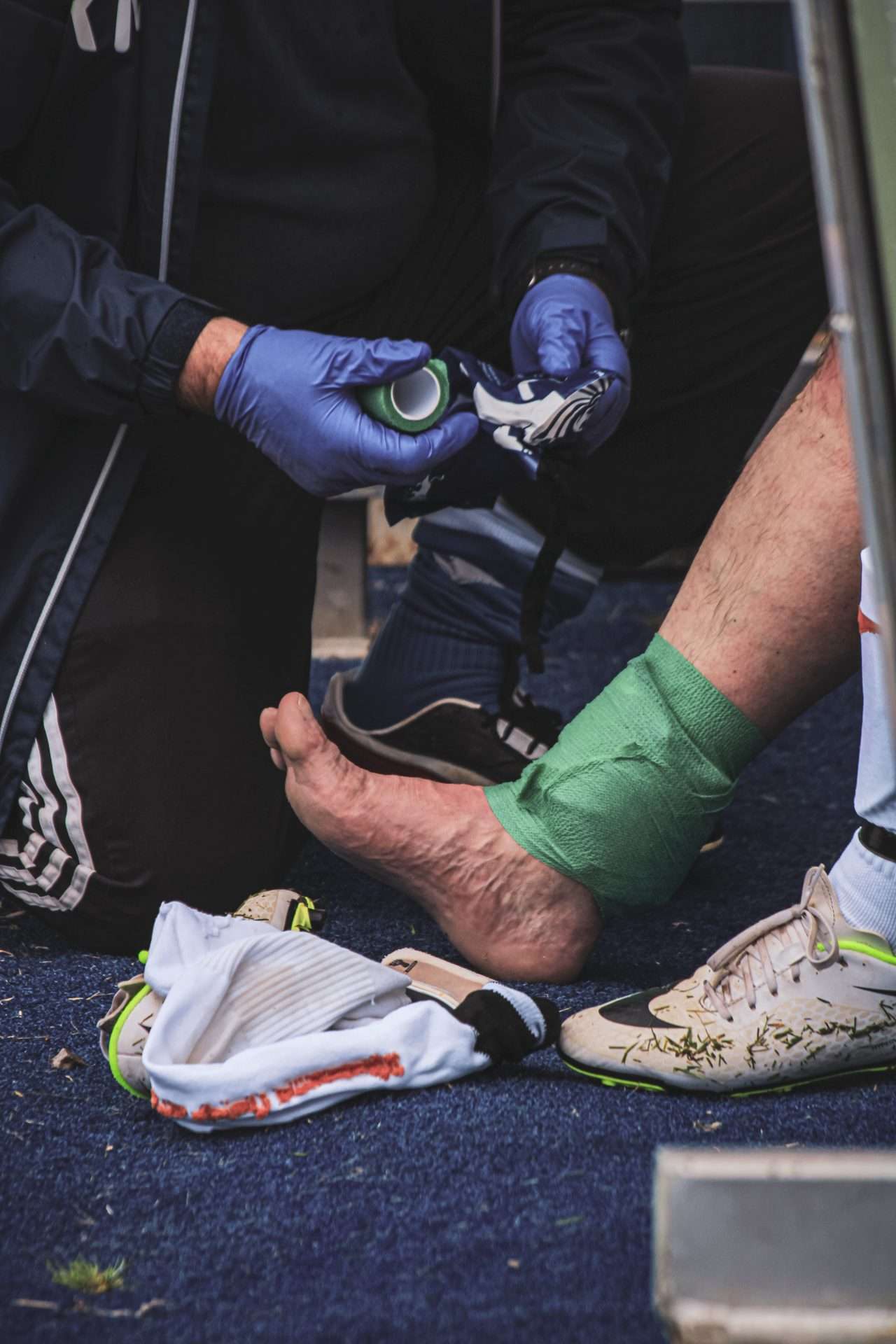
This is where the two diverge most sharply. A rolled ankle often has you walking comfortably within days, while a syndesmotic injury frequently doubles or triples that timeline.
Typical ankle sprain recovery expectations
- Most sprains and strains feel better after about 2 weeks.
- Strenuous exercise such as running is often avoided for up to 8 weeks.
- High ankle sprains commonly take twice as long as lateral sprains.
- Elite athletes averaged approximately 58 days to return to sport after syndesmosis injuries.
- Severe cases with separation can extend well past three months.
- Rushing ankle sprain recovery is the most common cause of setbacks.
What the return-to-sport research shows
- The pooled return-to-sport rate reached 96% across studies.
- That analysis covered fourteen studies and 901 elite athletes.
- Suture-button fixation and nonoperative care both reached 98%.
- Outcomes were comparable regardless of management approach.
- Individualizing by severity and sport demands still matters.
- High return rates don’t mean short timelines.
Our founder has appeared as a featured guest on the Chiro Hustle Podcast discussing exactly this kind of measured, criteria-based approach to return.
What extends ankle sprain recovery
- Returning to sport before rotation tolerance returns.
- Skipping the balance and proprioception side of physical therapy.
- Ignoring calf and hip strength deficits.
- Persistent swelling that nobody treats as feedback.
- Missed diagnosis in the first two weeks.
- Repeat injury before full healing.
Related: Can Balance Issues Be Treated Without Medication?
How Is a High Ankle Sprain Treated?
Treatment starts with protection, moves into restoring rotation tolerance, and finishes with the strength and balance work that prevents the next one. Stable injuries are managed without surgery in most cases.
Early management that protects ankle sprain recovery
- Protection with a boot or brace when weight bearing hurts.
- Relative rest with crutches if walking produces limping.
- Ice through a cloth for up to 20 minutes at a time.
- Compression and elevation to control swelling.
- Early physical therapy motion work once acute pain allows.
- Medical review if you can’t bear weight at all.
Rehabilitation that restores capacity
- Physical therapy for calf, peroneal, and hip strength.
- Chiropractic care for foot, ankle, and knee mechanics.
- Soft tissue work on guarded calf and shin muscles.
- Balance and proprioception training on progressively unstable surfaces.
- Graded physical therapy rotation loading before any cutting drills.
- Hop and agility testing before clearance.
- Bracing or taping during the return-to-sport phase.
Taping can help, though modestly. A review of eight studies with 190 participants found kinesio taping produced a small but significant improvement in Y-Balance Test scores, and the authors positioned it as an adjunct to rehabilitation rather than a replacement for it.
When a sports injury needs a surgical opinion
- Radiographic separation of the tibia and fibula.
- Instability on stress testing under imaging.
- Associated fracture requiring fixation.
- Failure to progress after appropriate physical therapy and bracing.
- High-demand athletes with unstable injuries.
- Persistent ankle pain months after the initial injury.
Our clinics expanded access to that kind of staged rehabilitation through the acquisition of AllCare Chiropractic and Injury across four established practices.
Related: Benefits of Chiropractic Care: Pain Relief and Mobility
How Do You Keep Ankles Healthy for Decades?
An ankle injury at twenty-five shapes how the joint feels at fifty-five. Getting out of pain is the first phase, restoring balance and strength is the second, and keeping that capacity is what protects against chronic instability and arthritis later.
Habits that prevent future ankle pain
- Single-leg balance practice built into daily routine.
- Calf and foot strengthening twice weekly.
- Hip strength work, since the hip controls the landing.
- Footwear replaced before support degrades.
- Gradual increases in trail and uneven-terrain volume.
- Bracing during high-risk sport after a significant sports injury.
- Prompt evaluation of any repeat rolling episode.
Why repeat sprains matter so much
- Each sprain reduces the ankle’s position sense.
- Chronic instability develops from unaddressed deficits.
- Repeated injury accelerates cartilage wear over decades.
- Balance deficits raise fall risk in later life.
- Compensation shifts load to the knee and hip.
- Prevention costs far less than repeated ankle sprain recovery.
Where multidisciplinary care fits
- Chiropractic care for foot, ankle, and knee mechanics.
- Ongoing strength coaching after formal rehabilitation ends.
- Massage therapy during heavy training periods.
- Regenerative options when degenerative change follows old injury.
- Nutrition and metabolic support for tissue repair.
- Periodic balance screening even without symptoms.
- One record that follows you across years of care.
Our COO’s profile in the Washington Business Journal traced that long-horizon philosophy, and our founder has explained the same approach as a featured expert on ABC7’s Good Morning Washington.
Related: Anterior Pelvic Tilt: Causes, Symptoms, and Chiropractic Treatment
FAQs
How can I tell if I have a high ankle sprain at home?
Notice where the pain sits. Tenderness several inches above the ankle joint, especially with the foot rotating outward, points toward the syndesmosis rather than the outer ligaments. Being able to walk doesn’t rule it out, so an examination is worth the visit if the pain sits high.
Why does a high ankle sprain take so much longer to heal?
The syndesmotic ligaments resist forces that occur with every step, so they get loaded constantly during normal walking. That makes true unloading harder to achieve than with the outer ankle ligaments. The tissue also has a less generous blood supply in the affected area.
Can I walk on a high ankle sprain?
Many people can, particularly with milder injuries, which is exactly why it gets underestimated. Walking with a limp is a signal to use crutches or a boot rather than push through. Being able to walk isn’t the same as being ready to load the joint properly.
Do high ankle sprains always need surgery?
No, and most stable injuries are treated without it. Surgery becomes relevant when imaging shows separation between the tibia and fibula or when stress testing reveals instability. Return-to-sport rates were similar for surgical fixation and nonoperative care in elite athletes.
When can I run again after a high ankle sprain?
Running typically resumes once you can walk pain-free, tolerate rotation loading, and hop without symptoms. That’s often six to ten weeks depending on severity, though it varies widely. Testing rather than the calendar should make the call.
Does taping or bracing actually help?
It helps modestly, with research showing small improvements in dynamic balance measures. The effect is measurable but limited, and it works best as a supplement to strengthening rather than a substitute. Think of it as insurance during the return phase, not treatment.
What happens if a high ankle sprain isn’t treated properly?
Persistent pain with push-off, ongoing instability, and reduced tolerance for cutting sport are the common outcomes. Untreated separation can also alter how load passes through the joint surface. That altered loading is what raises the odds of arthritis decades later.
Key Takeaways
- A high ankle sprain injures the syndesmosis above the joint, not the outer ankle ligaments.
- The mechanism is outward rotation over a planted foot rather than rolling inward.
- High ankle sprains make up only about 1% to 10% of all ankle sprains.
- Pain sits several inches above the joint and worsens with push-off and rotation.
- Early swelling is often modest, which is why the injury gets underestimated.
- Elite athletes averaged around 58 days to return to sport after syndesmosis injuries.
- Return-to-sport rates were similar for surgical and nonoperative management.
- Balance and strength work after recovery protects against chronic instability.
Find Lasting Relief From Ankle Sprain Pain and Instability
The practical difference between a high ankle sprain and a regular one is time. Both heal, both respond to good rehabilitation, and both are diagnosed largely by where the tenderness sits. The syndesmotic injury simply asks for more patience and more careful loading before you rotate and cut again.
Our clinics take that work past the point where walking stops hurting, into full rotation tolerance and balance control, and then into the habits that keep the joint stable for decades. An ankle you can trust on uneven ground at sixty is the outcome worth building toward.
Ready to take the next step toward recovery? Schedule your consultation online to visit RxWellness today and begin your path to relief.