

Table of Contents
A sports injury in Alexandria may be more than ordinary soreness when pain is focal, begins during a specific movement, limits normal function, worsens, or fails to improve on a typical post-exercise timeline. Delayed-onset muscle soreness (DOMS) usually develops after unfamiliar or strenuous activity and gradually settles as the affected muscles recover.
DOMS can temporarily reduce joint motion, force production, shock absorption, and normal muscle recruitment, so feeling “just sore” does not necessarily mean you are ready for unrestricted high-intensity activity — ResearchGate.
If you are unsure whether post-workout soreness is normal recovery or an athletic injury, RxWellness Alexandria can assess your movement, function, and musculoskeletal findings to determine whether conservative care is appropriate.
Related: How Can Plantar Fasciitis Treatment in Alexandria Relieve Heel Pain?
What Signs Suggest a Sports Injury Is More Than Normal Soreness?
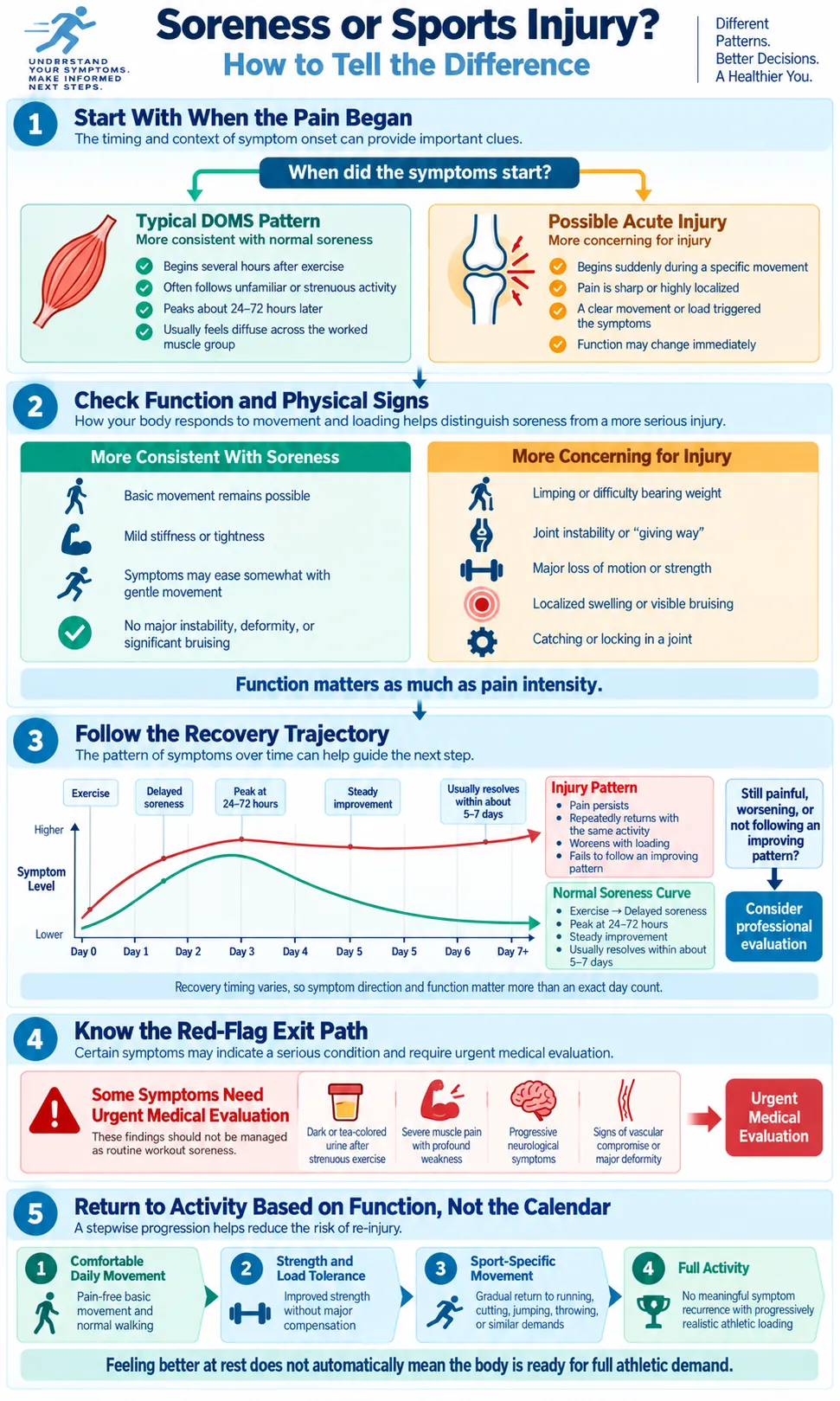
Normal soreness tends to follow a delayed, predictable, and improving course. An injury is more likely when pain starts suddenly, remains highly localized, interferes with weight-bearing or movement, or is accompanied by swelling, bruising, instability, or systemic warning signs.
DOMS generally resolves within several days. Pain lasting about a week or longer may reflect an injury rather than ordinary soreness, while unusually dark urine after strenuous exercise warrants medical evaluation—Cleveland Clinic.
Timing and Pain Pattern
When symptoms begin can provide an important clue. Ordinary post-workout soreness typically appears after exercise, not at the exact moment a movement stresses tissue.
- DOMS usually develops several hours after exercise.
- Soreness often peaks at 24–72 hours.
- Typical muscle soreness should progressively improve afterward.
- Sudden movement-specific pain is more consistent with acute injury.
Timing alone cannot diagnose the problem, but it helps determine whether closer assessment makes sense.
Location and Function
Pain distribution and its effect on movement can also separate common soreness from a more concerning exercise-related injury.
- DOMS is usually diffuse across the worked muscle group.
- Structural injuries often produce more localized point tenderness.
- Limping or inability to bear weight deserves evaluation.
- Instability or significant loss of motion is concerning.
A person may still be able to move an injured area, so consider function alongside other findings.
Swelling, Bruising, and Red Flags
Visible changes deserve attention because they are less typical of uncomplicated DOMS, especially when they appear quickly or are concentrated around one area.
- Generalized tightness can occur with normal muscle soreness.
- Rapid, localized swelling is not typical of DOMS.
- Visible bruising can accompany local tissue and blood-vessel disruption.
- Dark urine after strenuous exercise needs medical evaluation.
These signs can help you tell when “training soreness” may no longer be the best explanation.
New to RxWellness? Your first visit — including consultation, examination, and treatment — is just $19. Book your new patient appointment today.
What Treatment Options Are Used for a Sports Injury?
Treatment depends on what’s causing the symptoms. Mild DOMS, a muscle strain, an overuse injury, a major ligament injury, and a bone injury do not require the same approach. Early care may involve activity modification, while more serious findings can require medication, imaging, injections, orthopedic care, or surgery.
Activity Modification and Recovery
Early management does not always mean complete rest. The goal is to reduce excessive load while preserving safe movement when conditions allow.
- Mild DOMS may tolerate light active recovery.
- Training intensity may need temporary reduction.
- Limping or altered mechanics should prompt you to stop high-intensity activity.
- Prolonged complete rest is not universally appropriate.
Traditional RICE-style thinking may be part of early self-management, but activity should ultimately match the tissue involved and your functional response.
Medication, Injections, and Other Care
Medication- or injection-based treatment may have a role in selected diagnosed conditions. Still, neither should be treated as a universal answer to post-exercise pain.
- NSAIDs may be appropriate in some musculoskeletal situations.
- Medication is not suitable for every injury.
- Selected conditions may warrant injection-based treatment.
- Suspected rhabdomyolysis requires urgent medical care.
Simply stretching harder is also not a reliable solution. Post-exercise stretching used alone has not been shown to significantly improve soreness, strength, performance, flexibility, or pain threshold — ResearchGate.
When Surgery or Imaging Enters the Picture
Some symptoms require more than self-care or routine conservative management, particularly when the findings suggest major structural damage.
- X-rays help assess suspected fractures or dislocations.
- MRI may evaluate significant soft-tissue or bone-stress pathology.
- Major ruptures may require orthopedic or surgical assessment.
- Surgery is not standard treatment for ordinary DOMS.
The next right step depends on the suspected tissue, severity, and functional impact rather than pain intensity alone.
What Can Conservative Care Help You Regain After a Sports Injury?
Once emergency problems and unstable structural injuries have been ruled out, conservative care can focus on restoring movement, strength, control, and tolerance for progressively greater activity. The objective is not simply to make pain disappear, but to help your body handle the demands of daily life and the eventual return to sports.
Movement and Load Tolerance
Sports injury recovery often starts by identifying which movements remain comfortable and which loads exceed your current capacity.
- Assess pain-free active and passive movement.
- Rebuild tolerance through progressively loaded activity.
- Address compensation that develops in response to painful movement.
- Separate everyday function from sports-level demands.
Improving basic movement is important, but athletic readiness usually requires a higher functional threshold.
Strength and Control
Pain may settle before force production and joint control have fully recovered. That makes strength and movement quality important parts of conservative rehabilitation.
- DOMS and injury can temporarily reduce force production.
- Strength should improve before unrestricted high-load activity.
- Joint control matters alongside symptom reduction.
- Rehabilitation should progress according to functional response.
The next stage is to determine whether those improvements carry over to the movements your activity actually requires.
Safer Return to Activity
Return to activity in stages rather than jumping directly from rest to full competition or training intensity.
- Progress from daily activity toward sport-specific demands.
- Reintroduce running, cutting, throwing, or jumping gradually.
- Post-activity flares may signal inadequate load tolerance.
- No pain at rest does not equal readiness for competition.
A graded return helps reveal whether function has recovered under increasingly realistic athletic demands.
If you’re ready to address a sports injury in Alexandria, our team at RxWellness is here to help. Call (703) 972-1472 to schedule your consultation today.
What Should You Expect When a Sports Injury Is Evaluated?
A professional evaluation looks beyond a single pain description. Clinicians consider when symptoms began, how they are changing, whether function is limited, what movements reproduce the problem, and whether physical findings suggest imaging, lab testing, an orthopedic referral, or conservative treatment.
History and Symptom Timeline
The story behind the pain helps establish whether the pattern resembles ordinary soreness, an acute event, or a recurring load-related problem.
- Identify whether pain began during or after activity.
- Determine whether symptoms are improving, stable, or worsening.
- Note pain that returns whenever training resumes.
- Review recent increases in volume or unfamiliar loading.
That history provides context for the movement and physical findings identified during examination.
Movement and Physical Examination
A physical examination can reveal functional limitations that are difficult to judge from pain intensity or symptom descriptions alone.
- Assess gait and tolerance for weight-bearing.
- Compare active and passive range of motion.
- Check for tenderness, swelling, bruising, or instability.
- Evaluate strength and compensatory movement patterns.
These findings help determine whether the problem warrants conservative management.
Imaging and Diagnostic Decisions
Imaging isn’t automatically needed just because you feel sore after exercise. Select testing when the clinical picture warrants further evaluation.
- Uncomplicated muscle soreness usually does not require imaging.
- X-rays may assess fractures or dislocations.
- MRI may examine substantial soft-tissue or bone-stress pathology.
- Suspected systemic muscle breakdown requires urgent laboratory evaluation.
Selective testing helps align the evaluation with the problem rather than treating every athletic complaint the same way.
When Should You Have a Sports Injury Professionally Evaluated?
Mild, diffuse soreness that improves steadily can often be monitored. Professional evaluation is more appropriate when symptoms persist, recur with the same activity, worsen rather than improve, impair normal function, or include structural or systemic warning signs that fall outside a typical DOMS pattern.
Persistent or Recurring Symptoms
Time matters because ordinary soreness should improve, not remain unchanged week after week.
- Pain lasting about a week without improvement deserves assessment.
- Recurrent pain with the same load is concerning.
- Rest or nighttime pain is not typical of uncomplicated DOMS.
- Worsening symptoms should be professionally evaluated.
Persistent athletic pain may reflect a problem that needs a more specific diagnosis or management plan.
Structural Injury Warning Signs
Certain musculoskeletal findings raise greater concern for a meaningful tissue or joint injury, especially when normal function has changed substantially.
- Inability to bear weight requires closer evaluation.
- Catching, locking, or instability may indicate joint involvement.
- Marked focal weakness or loss of motion is concerning.
- Significant swelling, bruising, or deformity needs assessment.
These findings may require imaging or referral before conservative treatment is considered appropriate.
Urgent Medical Red Flags
Some post-exercise symptoms should not be managed as routine soreness or a standard sports injury in an Alexandria office visit.
- Dark or tea-colored urine requires medical attention.
- Severe muscle pain with profound weakness is concerning.
- Progressive neurological or vascular changes require urgent assessment.
- Suspected exertional rhabdomyolysis needs urgent medical evaluation.
Exertional rhabdomyolysis involves exercise-related muscle breakdown and may present with severe muscle pain, abrupt elevation of creatine kinase, and myoglobinuria; recurrent episodes may require further investigation — PMC.
How Do You Know When It Is Safe to Return to Sports?
No universal number of rest days makes every athletic injury safe. Return depends on how symptoms are progressing, whether movement and strength have recovered, whether you can tolerate increasing load without compensation, and what specific tissue or injury is involved.
Normal Soreness Timeline
DOMS has a recognizable trajectory, although individual recovery can still vary after unfamiliar or demanding exercise.
- Symptoms develop after exercise, not during it.
- Soreness commonly peaks within 24–72 hours.
- Progressive improvement should follow the peak.
- Typical DOMS resolves within roughly five to seven days.
If you don’t follow that improving pattern, consider a professional evaluation.
Functional Readiness
Time alone cannot confirm readiness. Your body also needs to tolerate the movement and loading required by the activity you plan to resume.
- Active and passive movement should be pain-free.
- Strength and load tolerance should be restored.
- Limping or major compensation should be absent.
- Sport-specific movements should not reproduce symptoms.
Those criteria help distinguish feeling comfortable during ordinary activity from being prepared for athletic demands.
Injury-Specific Progression
A diagnosed injury may need a much different progression than ordinary soreness because tissue type and injury severity affect how much loading is appropriate.
- Recovery timelines vary by tissue type and severity.
- Some serious injuries require staged rehabilitation.
- High-risk bone stress injuries may require complete offloading.
- Everyday comfort does not equal maximal athletic readiness.
Bone stress injuries illustrate why return plans cannot be standardized: walking may remain appropriate for some low-risk injuries, while high-risk injuries can require complete offloading — Physio-Learning.
Related: Finding the Right Sports Chiropractor Near Me in Alexandria, VA
Why Choose RxWellness Alexandria for Sports Injury Care?
RxWellness Spine & Health Alexandria approaches musculoskeletal complaints by looking at movement, function, spinal and joint mechanics, and rehabilitation needs together. The clinical team can determine whether conservative care is appropriate based on the findings, while recognizing situations that may require imaging, orthopedic evaluation, or emergency medical attention instead. That distinction matters for active patients because the appropriate next step can range from modified activity and rehabilitation to referral for further diagnostic evaluation.
- A board-certified clinical team provides care under physician oversight.
- More than 150,000 patients have been treated across RxWellness locations.
- Patients have shared more than 7,500 five-star reviews across the network.
- RxWellness has earned recognition on the INC 5000 for four consecutive years, from 2023 through 2026.
- RxWellness ranked #1,230 on the 2026 INC 5000 list.
- The organization ranked #135 in the Healthcare and Medical category on the 2026 INC 5000 list.
- In Virginia, RxWellness ranked #51 in 2026.
- In the Washington-Arlington-Alexandria, DC-VA-MD-WV metro, RxWellness ranked #53 in 2026.
That broader clinical perspective supports care that can change as your symptoms and functional abilities change.
The RxWellness Three-Phase Care Model
When conservative treatment is appropriate, care can progress through three phases that address immediate symptoms, functional deficits, and continued support.
- Relief Care: Reduce discomfort and stabilize the presenting condition.
- Corrective Care: Rebuild strength, stability, mechanics, and movement capacity.
- Wellness Care: Support continued function through care, movement, and education.
This progression connects symptom management with the functional demands of returning to activity.
How Does RxWellness Treat a Sports Injury in Alexandria?
RxWellness Alexandria uses confirmed conservative services based on the findings identified during the evaluation. Treatment for a sports injury in Alexandria may combine care to address appropriate mechanical restrictions with rehabilitation that rebuilds movement capacity, strength, and load tolerance, rather than relying on a single intervention for every athletic complaint.
Chiropractic Care
Chiropractic care may be appropriate when examination identifies a musculoskeletal or spine-related mechanical component and serious or unstable conditions have been excluded.
- Evaluate spinal and joint mobility.
- Identify mechanical restrictions associated with symptoms.
- Address appropriate spine-related mechanical dysfunction.
- Integrate care with movement and rehabilitation.
This approach keeps mechanical treatment connected to the broader functional picture rather than treating an adjustment as a stand-alone solution.
Rehabilitation Therapy
Rehabilitation Therapy focuses on gradually restoring function rather than assigning everyone the same recovery timetable.
- Use progressive loading when clinically appropriate.
- Rebuild strength and tolerance for physical demands.
- Improve movement quality after injury-related compensation.
- Progress toward activity-specific functional requirements.
Together, these services enable the Alexandria team to align conservative treatment with your findings and functional needs.
Ready to take the next step toward recovery? Schedule your consultation online to visit RxWellness Alexandria today and begin your path to relief.
Frequently Asked Questions
Is it safe to exercise with a sports injury in Alexandria?
Mild, diffuse delayed-onset muscle soreness may allow light activity if movement remains comfortable and symptoms continue improving. Stop higher-intensity exercise if you have sharp or highly focal pain, limping, instability, or worsening symptoms. Once an injury has been identified, return to exercise should follow a plan based on the specific condition and functional response.
Does insurance cover treatment for a sports injury in Alexandria?
RxWellness Alexandria accepts Aetna, BCBS (Blue Cross Blue Shield), CareFirst Blue Cross Blue Shield, Cigna, FSBP, GEHA, Medicare, and UHC (United Healthcare). Coverage depends on your plan and the services provided, so verify benefits before treatment. The $19 New Patient Special is cash-pay only and cannot be combined with insurance billing.
How long should soreness last before I get it checked?
Delayed-onset muscle soreness typically peaks at 24–72 hours after exercise and then begins to improve progressively. If symptoms remain unchanged or continue for about a week, professional evaluation may be appropriate. You should also consider evaluation when the same pain repeatedly returns as soon as you resume a particular exercise, training load, or activity.
What happens at my first RxWellness Alexandria visit for a sports injury?
Your first visit includes a consultation and examination focused on how the symptoms began, how they behave, and how they affect movement and function. When findings indicate conservative care is appropriate, we select treatment accordingly. The confirmed $19 first-visit offer includes consultation, examination, and treatment for new patients.
How do I know whether I am a candidate for conservative sports injury care?
Conservative care may be appropriate after fractures, unstable joint injuries, major ruptures, systemic emergencies, and other important red flags have been ruled out. Candidacy depends on the tissue involved, injury severity, functional findings, and whether treatment can be provided safely. Findings that do not respond to conservative management may require imaging, referral, or urgent medical care instead.
Key Takeaways
- Normal DOMS is delayed, usually peaks within 24–72 hours, and should progressively improve over several days.
- Focal pain, impaired function, instability, swelling, bruising, or worsening symptoms can point toward an athletic injury.
- RxWellness Alexandria evaluates movement and function before determining whether conservative musculoskeletal care is appropriate.
- Conservative care can focus on movement, strength, load tolerance, control, and graded return to activity.
- The three-phase care model progresses from symptom stabilization to corrective work and continued functional support.
- Return to sports depends on functional readiness and the specific injury, not a fixed recovery timetable.
Related: Can Carpal Tunnel Treatment in Alexandria Relieve Hand Numbness?
Get a Sports Injury in Alexandria Evaluated at RxWellness
A sports injury in Alexandria deserves closer attention when symptoms no longer resemble ordinary soreness. Persistent or focal pain, loss of function, instability, significant swelling, or systemic warning signs can signal that evaluation is better than training through discomfort.
At RxWellness Alexandria, the clinical team evaluates movement, joint and spinal mechanics, strength, and functional limitations to determine whether conservative care is appropriate. When it is, chiropractic care and rehabilitation therapy may help restore movement, rebuild load tolerance, and support a gradual return to activity. Findings that suggest a fracture, major structural injury, or other red flag may require imaging, referral, or urgent medical evaluation instead.
RxWellness Spine & Health Alexandria Online Reservations
3543 West Braddock Road, Suite 200, Alexandria, VA 22302
The clinic serves patients from Alexandria and nearby communities, including Old Town Alexandria, Huntington, Belle Haven, Fairlington, and Shirlington.