
Table of Contents
ACL injury recovery in Vienna can absolutely improve knee stability — when treatment addresses both the injured ligament and the biomechanical imbalances that compromise joint function long after initial healing. “There are approximately 400,000 ACL reconstructions every year in the United States” — StatPearls/NCBI Bookshelf.
At RxWellness Spine & Health in Vienna, our sports chiropractic team delivers integrated, performance-focused care designed to restore symmetrical strength, retrain joint proprioception, and protect your knee for the long term.
Related: How Can Sports Injury Rehab in Vienna Help Me Recover?
What Causes ACL Injuries and When Should You Seek Treatment?
ACL injuries most commonly occur during high-demand athletic movements — sudden stops, cutting, pivoting, or awkward landings. Still, contact collisions account for a significant share as well. Understanding the mechanisms and warning signs of ACL injury is the first step toward timely care that protects your knee stability now and in the future.
Contact vs. Non-Contact Injury Mechanisms
The ACL is the primary stabilizer that prevents the tibia from sliding forward on the femur, and it is subjected to extreme stress during explosive athletic movements. Both contact and non-contact forces can rupture the ligament.
- Non-contact tears: sudden deceleration, cutting, or jump landing
- Contact tears: direct blow to the knee or lower leg
- Classic mechanism: slight knee flexion combined with valgus collapse
- Non-contact tears account for 37.9% of high school ACL injuries
“Girls’ soccer had the highest injury rate (12.2) followed by boys’ football (11.1), with boys’ basketball (2.3) and boys’ baseball (0.7) having the lowest rates”— PMC3867093.
Female athletes face anatomical and neuromuscular disadvantages — including quadriceps-dominant deceleration patterns and increased knee valgus angulation during landing — that amplify injury risk at equivalent activity levels.
High-Risk Populations and Sport Contexts
Certain athletes carry disproportionately elevated risk due to age, anatomy, sport demands, and competitive environment. Identifying these risk factors immediately after injury helps clinicians design programs that address the whole athlete.
- Female athletes: 2 to 4.5 times greater injury risk than their male counterparts
- Athletes competing vs. practicing: seven times higher injury likelihood during competition
- Adolescents and young adults in pivoting and jumping sports face peak susceptibility
- Up to 23% of young athletes sustain a secondary ACL injury within two years of return to sport
Warning Signs and Immediate Symptoms
Recognizing the immediate signs of an ACL injury enables faster diagnosis. It prevents further joint damage from unprotected weight-bearing on an unstable knee. Delayed evaluation often worsens meniscal or cartilage involvement.
- Audible “pop” or popping sensation at the moment of injury
- Rapid, tense joint swelling (hemarthrosis) within hours
- Severe pain and immediate inability to continue the activity
- Distressing sensation of the knee “giving way” or buckling
The combination of an audible pop and rapid swelling carries approximately a 65% positive predictive value for a confirmed MRI finding. If you experience these warning signs after a sports injury or fall in Vienna, prompt evaluation is essential.
New to RxWellness? Your first visit — including consultation, examination, and treatment — is just $19. Book your new patient appointment today!
What Are the Treatment Options for ACL Injury Recovery?
ACL injury recovery in Vienna is not a one-size-fits-all process, and the most appropriate treatment path depends on your age, activity demands, injury severity, and personal goals. A credible care team will present the full range of evidence-based options — surgical, conservative, and integrative — before building a recovery plan with you.
Conservative Rehabilitation-First Management
For many patients — particularly recreational athletes, older adults, and those without subjective buckling episodes — structured physical rehabilitation without immediate surgery produces outcomes equivalent to early reconstruction. This approach prioritizes restoring quadriceps strength, range of motion, and neuromuscular control through progressive exercise programming.
- RICE protocol (rest, ice, compression, elevation) in the acute phase
- Progressive physical therapy focused on quadriceps and hamstring symmetry
- Functional bracing to support dynamic stability during loading activities
- NSAIDs and anti-inflammatory management for early pain and swelling control
“The KANON trial concluded that a strategy of early reconstruction plus rehabilitation did not provide better results at five years than a strategy of initial rehabilitation with optional delayed ACL reconstruction” — PMC10797880.
Notably, 39% of patients in the conservative group required delayed surgery within two years due to persistent instability, underscoring that this pathway requires rigorous clinical monitoring.
Surgical Reconstruction and Graft Options
Surgical ACL reconstruction is the established standard for high-demand athletes returning to pivoting and cutting sports, individuals with multi-ligamentous injuries, and patients experiencing significant knee instability. Surgery addresses the structural rupture but does not eliminate the need for comprehensive post-operative rehabilitation.
- BTB autograft: strong initial construct, lower revision rates, preferred for cutting sports
- Hamstring autograft: lower donor-site pain, but risk of long-term hamstring strength deficit
- Quadriceps tendon: large, vascularized option with low donor-site morbidity
- Allograft: eliminates harvest incision but carries significantly higher failure rates in younger athletes
Multimodal Conservative Care Integration
Whether managing ACL injury recovery conservatively or rehabilitating after surgery, integrating manual therapy, sports chiropractic, and specialized modalities accelerates healing and addresses kinetic chain deficits that traditional physical therapy alone may miss.
“Chiropractors contribute through joint mobilizations, extremity adjustments, and myofascial techniques that restore biomechanical balance, reduce inflammation, and improve post-surgical recovery” — PMC12535788.
- Extremity chiropractic adjustments to restore femur-tibia-patella alignment
- Instrument-assisted soft tissue mobilization for fascial restrictions and scar tissue
- Kinesio taping for proprioceptive support and early swelling control
- Progressive kinetic chain strengthening targeting gluteal, hamstring, and core stability
What Are the Benefits of Multidisciplinary ACL Injury Recovery in Vienna for Knee Stability?
Multidisciplinary ACL injury recovery in Vienna addresses biomechanical alignment, neuromuscular coordination, and long-term joint protection together, helping patients return to activity with greater confidence, symmetry, and resilience.
Restored Joint Alignment and Biomechanical Function
ACL deficiency alters the entire axis of knee joint rotation, shifting abnormal stress onto the lateral tibial plateau and degrading synovial fluid circulation. Restoring proper alignment through extremity adjustments decreases localized mechanical friction and corrects compensatory imbalances at the hip and ankle.
- Improved joint space symmetry reduces abnormal cartilage pressure
- Enhanced synovial fluid circulation supports tissue nourishment and waste clearance
- Pelvic, hip, and ankle alignment corrections prevent compensatory knee overload
- Restored patella tracking within the trochlear groove improves functional movement quality
Neuromuscular Control and Proprioceptive Retraining
The native ACL contains mechanoreceptors essential for joint proprioception — the real-time sense of joint position that drives automatic stabilizing muscle contractions. ACL injury destroys these receptors, producing persistent neuromuscular deficits that leave the knee vulnerable even after strength levels appear recovered.
- Single-leg stance progressions to variable surface perturbation training
- Nordic hamstring and physioball bridge exercises for posterior joint stability
- Glute bridge and clamshell protocols to prevent dynamic knee valgus during loading
- Limb Symmetry Index (LSI) targets of ≥ 90% symmetry in strength and hop testing before return to sport
Long-Term Protection Against Reinjury and Osteoarthritis
Research consistently documents that 50% to 90% of individuals progress to post-traumatic osteoarthritis within 10 to 20 years of ACL injury — PMC7092615.
This risk persists regardless of whether surgical reconstruction was performed. Comprehensive neuromuscular maintenance and kinetic chain conditioning are the most effective tools for protecting long-term knee health.
- Structured rehabilitation reduces secondary ACL injury rates in young athletes
- Criteria-based return-to-sport testing validates joint readiness before high-risk activity
- Long-term neuromuscular conditioning preserves symmetrical force distribution across joint cartilage
- Prevention programs incorporating proximal control, core stability, and plyometrics reduce primary and secondary injury rates
If you’re ready to find lasting relief from ACL knee instability in Vienna, our team at RxWellness is here to help. Call (703) 242-1415 to schedule your consultation today.
What Should You Expect During ACL Injury Recovery at RxWellness Vienna?
At RxWellness Vienna, our sports chiropractic team structures every stage of recovery around objective clinical milestones — not arbitrary timelines. Here is what to expect from your first visit through progressive return to function.
Initial Evaluation and Injury Assessment
Your first visit includes a comprehensive consultation and complete examination — orthopedic and neurological testing, postural and movement assessment, and on-site digital X-ray if indicated. The evaluation extends beyond the knee to assess the full kinetic chain from the outset.
- Full orthopedic and functional movement screen of the knee, hip, and ankle
- On-site digital X-ray available same day if clinically appropriate
- Assessment of injury history, sport demands, and return-to-activity goals
- Personalized care plan presented at the second visit, with treatment approach and timelines
Early Recovery Phase: Swelling, Extension, and Mobility
The early phase focuses on controlling swelling, restoring full knee extension, and re-establishing safe weight-bearing. Failing to achieve full passive extension in the first weeks is a well-documented predictor of long-term functional deficits.
- Kinesio taping is applied to reduce swelling and enhance proprioceptive feedback
- Massage therapy to decrease surrounding muscle tension and prepare tissue for active loading
- Manual therapy and instrument-assisted soft tissue work to address localized restriction
- Gradual progression to weight-bearing and normal gait mechanics as tolerated
Progressive Strengthening and Return-to-Function Milestones
Once foundational mobility is established, treatment shifts to progressive strength development across the entire lower extremity, with quadriceps symmetry serving as the central clinical benchmark for every major progression decision.
- Months 1–2: Full ROM restoration and quadriceps strength reaching 50%+ of uninjured side
- Months 3–4: Structured jogging program initiated after passing strength and movement criteria
- Months 6–9: Multiplanar agility, jumping, and cutting progressions introduced
- Months 9–12: Return to unrestricted sport after passing a comprehensive criteria-based test battery
Is Multidisciplinary ACL Injury Recovery in Vienna Right for You?
The right fit depends on where you are in the injury spectrum — from initial conservative management through post-surgical rehabilitation and return to competitive activity.
Patients Managing Partial Tears or Conservative Pathways
Patients with partial ACL tears or complete ruptures pursuing conservative management benefit substantially from sports chiropractic and multimodal care. Avoiding surgery requires that the surrounding musculature provide sufficient dynamic joint stability through targeted strengthening and proprioceptive retraining.
- Recreational athletes and non-pivoting sport participants with low instability complaints
- Older adults prioritizing pain reduction and functional mobility over return to competition
- Patients trialing structured rehabilitation before committing to surgery
- Individuals with partial tears and intact secondary stabilizers who qualify for conservative management
Post-Surgical Rehabilitation Candidates
Patients who have undergone surgical reconstruction benefit from integrating sports chiropractic and manual therapy alongside formal physical therapy. The combination addresses soft-tissue restrictions, scar tissue, and kinetic chain imbalances that can frequently slow functional progress if left unaddressed.
- Post-surgical patients cleared for soft tissue and manual therapy by their surgeon
- Patients experiencing slow quadriceps activation, persistent swelling, or a restricted range of motion
- Athletes who completed formal PT but haven’t achieved return-to-sport criteria
- Individuals managing post-surgical scar tissue, patellar mobility restrictions, or compensatory tightness
Athletes and Active Adults Returning to Sport
Only 33% of athletes successfully return to competitive sport within one year post-surgery, and a substantial percentage never return to their pre-injury level of play — JOSPT.
Objective criteria-based testing confirms symmetrical strength, neuromuscular control, and psychological readiness before resuming high-risk activity.
- High school and collegiate athletes in soccer, basketball, football, and lacrosse
- Recreational adult athletes with pivoting and cutting sport demands
- Active adults returning to hiking, running, or recreational fitness after ACL injury
- Any patient requiring documentation of return-to-sport functional readiness
How Long Does ACL Injury Recovery Take to Restore Knee Stability?
ACL injury recovery timelines vary based on injury severity, treatment pathway, age, and the patient’s ability to meet objective clinical milestones at each phase. Realistic expectations are essential for compliance and sound progression decisions.
Phase-by-Phase Recovery Benchmarks
Modern rehabilitation has moved away from fixed calendar-based protocols. Progression is determined by specific functional criteria — range of motion targets, quadriceps strength ratios, and movement quality standards — rather than weeks elapsed since injury or surgery.
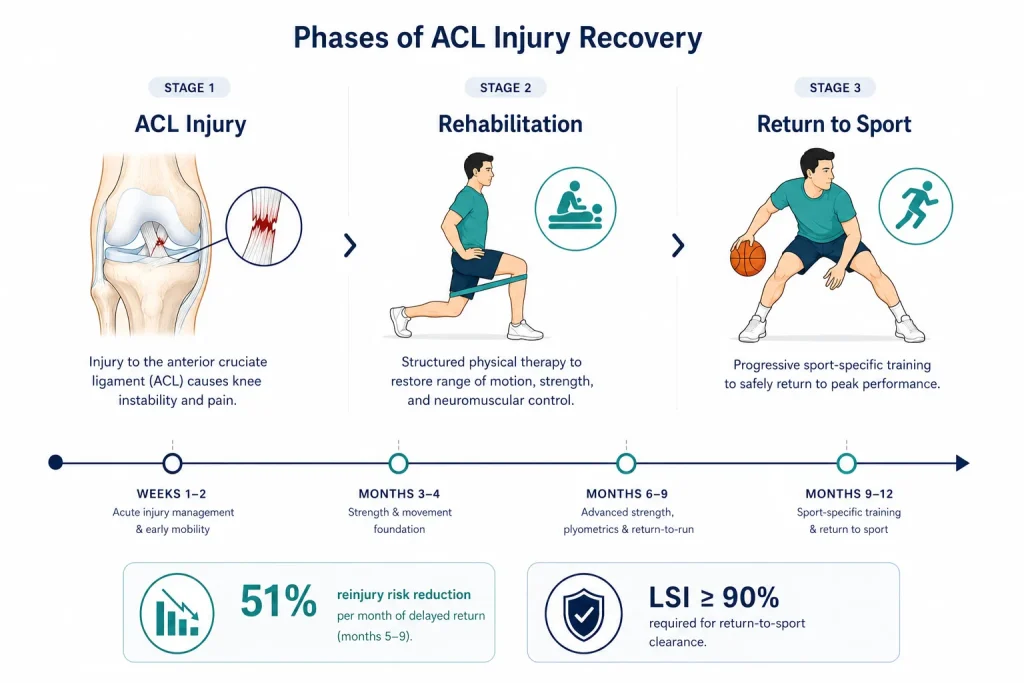
- Weeks 1–2: Full active knee extension and normal gait without assistive devices
- Weeks 3–4: Stair climbing and stationary cycling with improving quadriceps control
- Months 3–4: Progressive jogging program initiated after criteria-based strength assessment
- Months 6–9: Multiplanar agility, jumping, and controlled cutting progressions
Criteria-Based Return-to-Sport Progression
The benchmark for return-to-sport clearance is achieving a Limb Symmetry Index of at least 90% symmetry in both strength and functional hop testing. Psychological readiness must be validated alongside physical benchmarks.
- LSI ≥ 90% required in quadriceps strength and functional hop testing
- Psychological readiness validated using the ACL-Return to Sport after Injury (ACL-RSI) scale
- Multi-planar agility and deceleration testing under sport-specific conditions
- Full return to unrestricted competition typically occurs between months 9 and 12 post-surgery
Why Delayed Return Protects Long-Term Knee Health
Contemporary ACL research directly challenges the desire to return to sport as quickly as possible. “Research indicates that the incidence of reinjury is reduced by 51% per month for each month that return to sport is delayed between post-operative months 5 and 9” — PMC8811519.
For younger athletes in pivoting sports, delayed return until 18 to 24 months is recommended to allow complete biological graft maturation.
- Each additional month of delay between months 5–9 reduces reinjury risk by 51%
- Biological graft maturation requires 18–24 months in high-risk athletic populations
- Kinesiophobia (fear of reinjury) affects up to 24% of athletes and must be addressed clinically
- Secondary ACL injury rates approach 30% within two years of return to competitive sport in youth
Related: Can Chiropractic Care Help Chronic Elbow Pain in Vienna?
Why Choose RxWellness Vienna for ACL Injury Recovery?
RxWellness Spine & Health in Vienna is Northern Virginia’s premier sports chiropractic and performance care destination, with specialized expertise in ACL injury recovery, functional movement assessment, and criteria-based return-to-sport programming.
- Ranked #1,523 on the Inc. 5000 list of America’s fastest-growing companies (2025)
- Ranked #45 on the Inc. Regionals Mid-Atlantic list (2025)
- 150,000+ patients treated across 12 state-of-the-art Virginia and Maryland locations
- 7,500+ five-star reviews reflecting consistent, compassionate care
- Multidisciplinary team of board-certified chiropractors and licensed therapists
- Major insurance accepted: Aetna, BCBS, CareFirst, Cigna, FSBP, GEHA, Medicare, UHC
- Same-day appointments available for new and returning patients
- Serving Vienna, Oakton, and surrounding Northern Virginia communities
The RxWellness Three-Phase Care Model
At RxWellness Vienna, every ACL injury recovery plan follows the structured framework that defines our clinical approach.
- Phase 1 — Relief Care: Reduce acute pain, control swelling, and restore safe weight-bearing and foundational mobility
- Phase 2 — Corrective Care: Rebuild quadriceps and kinetic chain strength, correct biomechanical imbalances, and retrain neuromuscular control
- Phase 3 — Wellness Care: Maintain symmetrical strength, protect long-term joint health, and prevent secondary injury through ongoing conditioning
ACL Injury Recovery Treatment Approaches at RxWellness Vienna
Restoring knee stability after ACL injury demands more than isolated strengthening. At RxWellness Vienna, our integrated care model combines sports chiropractic, advanced soft-tissue therapy, and specialized modalities to address every dimension of recovery.
Sports Chiropractic Care and Extremity Adjustments
Sports chiropractic forms the biomechanical foundation of ACL injury recovery at RxWellness Vienna. Our chiropractors perform precise extremity adjustments to restore proper alignment between the femur, tibia, and patella — correcting the axis of joint rotation disrupted by ACL deficiency.
- Improved joint space symmetry reduces mechanical friction and cartilage degradation
- Pelvic, hip, and ankle realignment corrects compensatory loading on the healing knee
- Enhanced patella tracking within the trochlear groove supports pain-free functional movement
- Integrated functional movement assessment identifies kinetic chain deficits driving instability
Active Release Technique (ART)
Active Release Technique is a patented, movement-based soft tissue system that identifies and releases adhesions and scar tissue in the muscles, tendons, fascia, and nerves surrounding the knee. Following ACL injury or surgery, the quadriceps, hamstrings, IT band, and popliteal soft tissues commonly develop restrictions that impair range of motion and dynamic stability.
- Breaks down fascial adhesions and scar tissue, impairing quadriceps and hamstring function
- Restores muscle flexibility and joint range of motion through precise tension and movement
- Addresses IT band and popliteal restrictions that alter patellar tracking and knee mechanics
- Improves local circulation and tissue healing in the periarticular soft tissue environment
IASTM — Instrument-Assisted Soft Tissue Mobilization
RxWellness Vienna employs instrument-assisted soft tissue mobilization to address fascial restrictions and scar tissue throughout the lower extremity. IASTM tools detect tissue density changes that manual palpation may miss — particularly valuable for post-surgical scar tissue at graft harvest sites and portal incisions.
- Detects and breaks down dense scar tissue and fascial restrictions through controlled instrument contact
- Stimulates local fibroblast activity and angiogenesis to accelerate connective tissue remodeling
- Addresses graft harvest site scar tissue, portal incision restrictions, and capsular adhesions post-surgery
- Reduces pain by activating descending pain-modulating pathways and decreasing local muscle spasm
Kinesio Taping
Kinesio taping provides continuous proprioceptive cueing, structural support, and facilitation of lymphatic drainage throughout ACL injury recovery. Unlike rigid bracing, kinesio tape allows a full range of motion while delivering sensory feedback to the skin and underlying musculature between visits.
- Enhances proprioceptive feedback during weight-bearing and dynamic movement tasks
- Reduces swelling and edema through lymphatic facilitation in the early recovery phase
- Provides structural support during progressive loading without restricting the functional range of motion
- Reinforces correct neuromuscular activation patterns between clinical treatment sessions
Ready to take the next step toward recovery? Schedule your consultation online to visit RxWellness Vienna today and begin your path to lasting knee stability.
FAQs About ACL Injury Recovery in Vienna
Is ACL injury recovery treatment at a chiropractic clinic safe for post-surgical patients?
Yes — with appropriate surgical clearance, sports chiropractic and manual therapy are safe and beneficial for post-surgical ACL patients. RxWellness Vienna coordinates care according to your surgeon’s guidelines, initially focusing on swelling control and soft-tissue mobility before progressing to loading and strengthening.
Does insurance cover ACL injury recovery treatment in Vienna, VA?
RxWellness Vienna accepts Aetna, Blue Cross Blue Shield, CareFirst, Cigna, FSBP, GEHA, Medicare, and United Healthcare. Coverage varies by plan and diagnosis — our team will verify your benefits before your first visit. New patients without insurance can start with the $19 new patient special.
How long does ACL injury recovery in Vienna take to improve knee stability?
Most patients experience meaningful improvements in pain and mobility within the first 4 to 8 weeks. Quadriceps LSI targets of ≥90% are typically achieved between months 4 and 9. Full return to competitive sport is generally targeted between months nine and twelve, with delayed return recommended for high-risk pivoting sport populations.
What should I expect at my first ACL injury recovery appointment at RxWellness Vienna?
Your first visit includes a consultation, comprehensive orthopedic and functional movement examination, and your first treatment — all for $19. On-site digital X-ray is available if clinically indicated. A detailed care plan with treatment recommendations and timelines is presented at your second visit.
Who is a good candidate for multidisciplinary ACL injury recovery?
Multidisciplinary ACL recovery is appropriate for patients managing partial tears conservatively, post-surgical patients at any rehabilitation phase, athletes meeting criteria-based return-to-sport guidelines, and active adults restoring knee function after injury. If you are experiencing instability or difficulty returning to prior activity levels, a consultation with our Vienna sports chiropractic team is the right starting point.
Key Takeaways
- ACL injury recovery in Vienna is most effective when care addresses biomechanical alignment, neuromuscular control, and kinetic chain conditioning alongside the injured ligament
- RxWellness Vienna’s sports chiropractic and performance care team delivers integrated treatment — including extremity adjustments, ART, IASTM, and kinesio taping — to restore symmetrical strength and lasting knee stability
- Evidence-based rehabilitation prioritizes criteria-based progression over fixed timelines, with a Limb Symmetry Index ≥ 90% required before safe return to sport
- Delaying return to sport by each additional month between months 5 and 9 reduces reinjury risk by 51% — making structured, supervised recovery essential for long-term athletic health
- The RxWellness Three-Phase Care Model guides patients from acute pain and swelling control through corrective strengthening and into long-term wellness and injury prevention
- RxWellness Vienna serves patients in Vienna, Fairfax, Braddock, Dunn Loring, Merrifield, Burke, and surrounding Northern Virginia communities
Related: How Do I Know If I Have Plantar Fasciitis in Vienna?
Find Lasting Relief from ACL Injury Recovery in Vienna
ACL injury is one of the most physically and emotionally demanding setbacks an active person can face — but with the right multidisciplinary team, full recovery of knee stability is an achievable outcome.
At RxWellness Spine & Health in Vienna, our sports chiropractic specialists guide patients through every phase of ACL injury recovery, from initial evaluation through progressive strengthening and confident return to activity.
RxWellness Spine & Health Vienna/Oakton Online Reservations
360 Maple Ave W, Vienna, VA 22180
RxWellness Vienna proudly serves patients from Vienna, Fairfax, Braddock, Dunn Loring, and Merrifield, as well as the broader Northern Virginia community.